From time to time, I’d like to spotlight something I’ve read, watched, or listened to and how it inspires me to create better art, maybe even a better life.
Today, I wanted to share a poem by Bethany Tap originally published in the online literary magazine HAD.
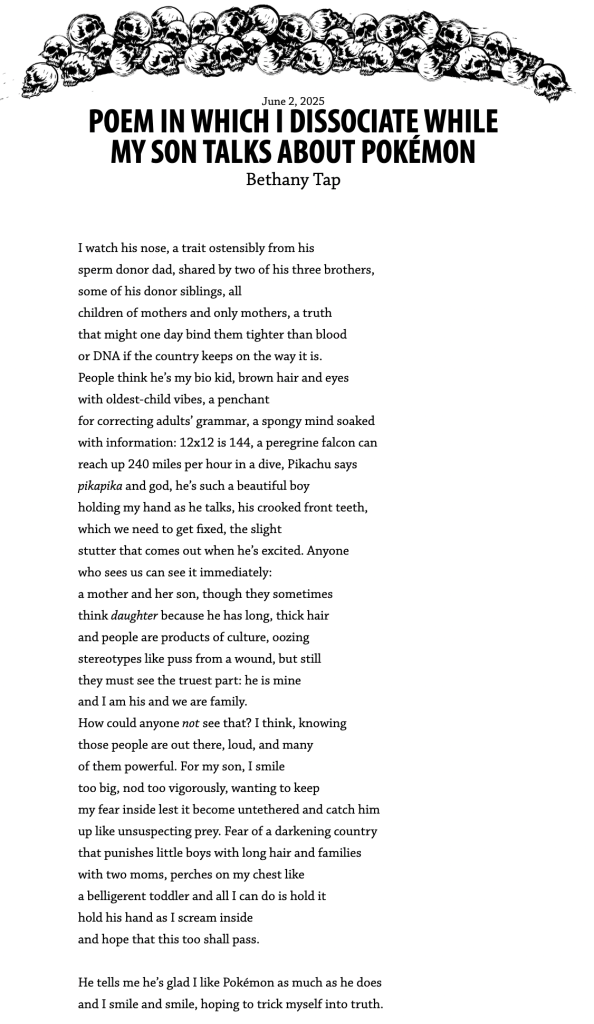
Here are the things that I admire about this poem.
Getting more concrete by inserting a very specific idea instead of a very specific noun
One of my favorite parts of the poem is the 12×12=144. I love it because it’s one of those details that makes the poem feel so vivid, yet it’s not a person, place, or thing you can picture.
When I’m writing, and I want to add more specifics into my poem, my natural instinct is to think of:
- Adding in more nouns (i.e. you see a woman on the side of the road? what if she’s eating bread?)
- Making existing nouns more precise (i.e. what flavor of bread is she eating? what’s the specific brand of the bread?)
- Describing existing nouns more vividly (i.e. how big is the bread? what if the bread was the same size as the woman eating it?)
While this poem does have its specific nouns and vivid descriptions, the list of specific ideas the son knows is just as effective, if not more effective, at bringing the story of the poem to life; 12×12=144 doesn’t paint a picture of what the child looks like, but it still paints a picture of who he is.
Telling, not showing, as a gut punch
One of the lines that grabbed me in this poem was “and god, he’s such a beautiful boy.” Something I’ve noticed I really enjoy in a poem is a straightforward line that stops you in your tracks, a line that suddenly arrives to say “Hey. I’m not mincing my words here. This is what is most true to me. I’m putting it plainly because I need you to know this.”
Many of us were taught that the best way to improve our writing is to show not tell. In fact, if this is poem was brought for a peer critique in one of my college poetry workshops, I can picture student writers (including myself) telling the author to cut the beautiful boy line because it feels like the right thing to say. Why tell us he is beautiful when you are showing us his nose, hair, and teeth?
Yet I love the beautiful boy line so much because it briefly takes the reader from a the more frantic place in the author’s head (what’s my son talking about at the moment? what do other people think? where is the country going?) into her place of joy. She adores her son. He is precious to her. Everything is chaotic, but this is what she knows for sure. She needs to pause and tell you that point blank so you know what’s at stake for her, and you don’t forget it.
I like the idea of reframing “show don’t tell” to “if you’re going to tell, make it mean something.” I also like the idea of setting aside conventional wisdom, experiencing art, and deciding for yourself whether conventional wisdom applies, instead of letting conventional wisdom keep you from appreciating something wonderful and human.
 Andrea
Leave a comment