- Art Study: Scenes From an Italian Restaurant
A few months ago, my mom recommended the new Billy Joel documentary (Billy Joel: And So It Goes). I love hearing artists talk about their work and the personal experiences that find their way into it. So I decided I too would watch, consuming the incredible 5 hour 2-part film in a series of short bursts as if spreading specks of glitter over the course of my summer.
Before the documentary, I didn’t really identify as a Billy Joel fan. I liked a lot of his songs. But I never sat down and thought much about the lyrics. Now, reading his words more closely, I am amazed at his singular gift.
In his documentary, Joel describes his own songwriting style as straightforward, as he often opts to express himself directly instead of building layers of metaphors for his audience to unpack. That simple presentation often belies impeccable craft. You listen to what he’s written and think, This sounds like stuff I hear every day, I could write a Billy Joel song! … but if you actually attempted to do that, you’d realize how difficult it is to fit the language of ordinary conversation into the tight, poetic packages Joel is able to create.
One of the songs I had heard over and over but never thought deeply about is “Scenes from an Italian Restaurant” from the 1977 album The Stranger.
Listening more closely, I am floored by these specific aspects of his songwriting.
Secret Ingredient Rhymes
When I write music, I at times struggle with choosing a fresh word for a rhyme. Hasn’t everybody already paired “you” and “new”? “Here” and “near”? “Best” and “all the rest”?
In “Scenes from an Italian Restaurant,” Joel does use a lot of rhymes you could pluck straight out of any rhyming dictionary. However, he also employs several unique words within his rhymes, words that function like secret ingredients; they are unusual choices, yet they elevate the work without shining so brightly you’re only thinking about how surprising it is that they’re there in the first place.
Some examples:
- bottle of whites + appetite
- want + italian restaurant
- ’75 + July
- apartment + deep pile carpet
- waterbed + bread
- the greasers + pick up the pieces
There are also a few rhymes that use specific proper nouns that add color while somehow fitting perfectly into the form of the song:
- jeans + New Orleans
- Eddie + steadies
- finer + Parkway Diner
- Sears + years + tears
More and more often, I notice that modern songwriters include proper nouns or other hyper-specific words in their lyrics, as Billy Joel does here. Yet for me personally, that kind of thing can sometimes be distracting, especially if it’s just one word thrown in there to add personality while the rest of the lyrics live in a more general world. In “Scenes from an Italian Restaurant,” Joel fully commits. Detail is not a clever trick; it’s the very fabric of the work. It’s the reason the song can be 7 minutes long and somehow still feel devoid of filler.
The Familiar, Hold the Obvious
When it comes to the casual, dialogue-like lines in this song, Joel also gets specific. So many phrases here are familiar but not obvious choices to express the ideas Joel is getting at. This is where I feel his artistry really shines.
One of my favorite examples of this is a line used to describe how beloved Brenda and Eddie were:
Nobody looked any finer
Or was more of a hit at the Parkway DinerThe easy choice here would be “everyone loved them.” Or maybe “they had so many friends.” Instead, Joel calls them a “hit,” opting for a more unexpected word choice, and offers us a concrete location to place these characters in, giving the listener an even more colorful picture of Brenda and Eddie’s life together.
Another great example is the last line of this verse:
Brenda and Eddie were still going
Steady in the summer of ’75
When they decided the marriage would
Be at the end of July
Everyone said they were crazy
Brenda you know that you’re much too lazy
And Eddie could never afford to live that
Kind of life
But there we were wavin’ Brenda and
Eddie goodbyeI love all of these lines, but I find the ending (“But there we were wavin’ Brenda and Eddie goodbye”) especially effective storytelling. Imagine another line in there, for example: “But they didn’t listen no matter how hard that we tried.” This replacement expresses the same idea (Brenda and Eddie got married anyways), but it’s so much less vivid. Instead of explaining, Billy Joel paints.
Joel may be coming up with these lines on the first go, but for me, this is a good reminder to question my first instincts. Are the words I’ve written words someone else has inevitably written before? Can I bring something fresher to the table?
Can I afford not to?
Full Lyrics Below
A bottle of whites, a bottle of red
Perhaps a bottle of rose instead
We’ll get a table near the street
In our old familiar place
You and I, face to faceA bottle of red, a bottle of whites
It all depends upon your appetite
I’ll meet you any time you want
In our Italian RestaurantThings are okay with me these days
Got a good job, I got a good office
I got a new wife, got a new life
And the family’s fine
We lost touch long ago
You lost weight I did not know
You could ever look so nice after
So much timeDo you remember those days hanging out
At the village green
Engineer boots, leather jackets
And tight blue jeans
You drop a dime in the box play a
Song about New Orleans
Cold beer, hot lights
My sweet romantic teenage nightsBrenda and Eddie were the
Popular steadies
And the king and the queen
Of the prom
Riding around with the car top
Down and the radio on
Nobody looked any finer
Or was more of a hit at the
Parkway Diner
We never knew we could want more
Than that out of life
Surely Brenda and Eddie would
Always know how to surviveBrenda and Eddie were still going
Steady in the summer of ’75
When they decided the marriage would
Be at the end of July
Everyone said they were crazy
Brenda you know that you’re much too lazy
And Eddie could never afford to live that
Kind of life
But there we were wavin’ Brenda and
Eddie goodbyeWell they got an apartment with deep
Pile carpet
And a couple of paintings from Sears
A big waterbed that they bought
With the bread
They had saved for a couple
Of years
They started to fight when the
Money got tight
And they just didn’t count on
The tearsThey lived for a while in a
Very nice style
But it’s always the same in the end
They got a divorce as a matter
Of course
And they parted the closest
Of friends
Then the king and the queen went
Back to the green
But you can never go back
There againBrenda and Eddie had had it
Already by the summer of ’75
From the high to the low to
The end of the show
For the rest of their lives
They couldn’t go back to
The greasers
The best they could do was
Pick up their pieces
We always knew they would both
Find a way to get by
That’s all I heard about
Brenda and Eddie
Can’t tell you more than I
Told you already
And here we are wavin’ Brenda
And Eddie goodbyeA bottle of red, a bottle of whites
Whatever kind of mood you’re in tonight
I’ll meet you anytime you want
In our Italian Restaurant - Art Study: Fast Gas
Today, I wanted to share “Fast Gas,” a poem by Dorianne Laux from her 1994 book What We Carry (screenshot taken from Poetry Foundation).
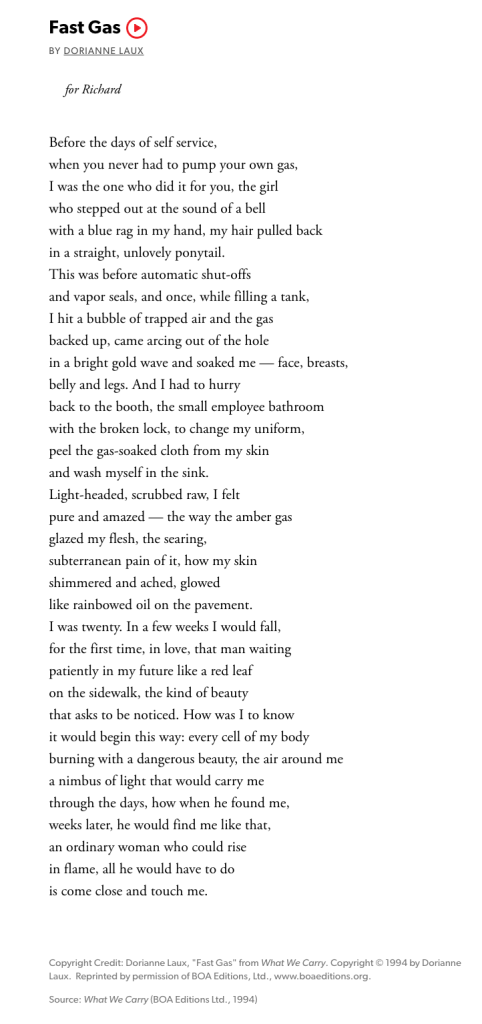
Here are the things I admire about this poem.
Exquisite Word Choice
The first phrase that stopped me in this poem was “unlovely ponytail.” To choose to call the ponytail unlovely, an uncommon word that does not scream ugliness but does concede that loveliness is absent, feels careful, maybe even kind; with her word choice, Laux precisely depicts a no-frills environment without passing judgment upon it.
The second phrase that stopped me was “the kind of beauty that asks to be noticed.” I love the use of the word asks here instead of something like begs or demands. It hammers home the idea of a love that was patiently waiting without undermining its ultimate remarkableness.
Subtle but Unmistakeable Juxtaposition
One of the embarrassing instincts I have as a writer is to always spell out connections I’m drawing between two ideas. I think when I get excited about something I am building, I become increasingly afraid that the reader won’t see what I want them to see and start relying on explication as an ugly creative crutch.
I love how in this poem, Laux is very clearly putting two images side by side (being soaked in gas and falling in love) but does not bridge them with an explicit transition. She simply tells one story and then peppers the next with language that masterfully references the prior visual (dangerous beauty, rise in flame, come close and touch me). It is a reminder of how saying less can sometimes conjure more.
- Art Study: Poem in Which I Dissociate While my Son Talks about Pokémon
From time to time, I’d like to spotlight something I’ve read, watched, or listened to and how it inspires me to create better art, maybe even a better life.
Today, I wanted to share a poem by Bethany Tap originally published in the online literary magazine HAD.
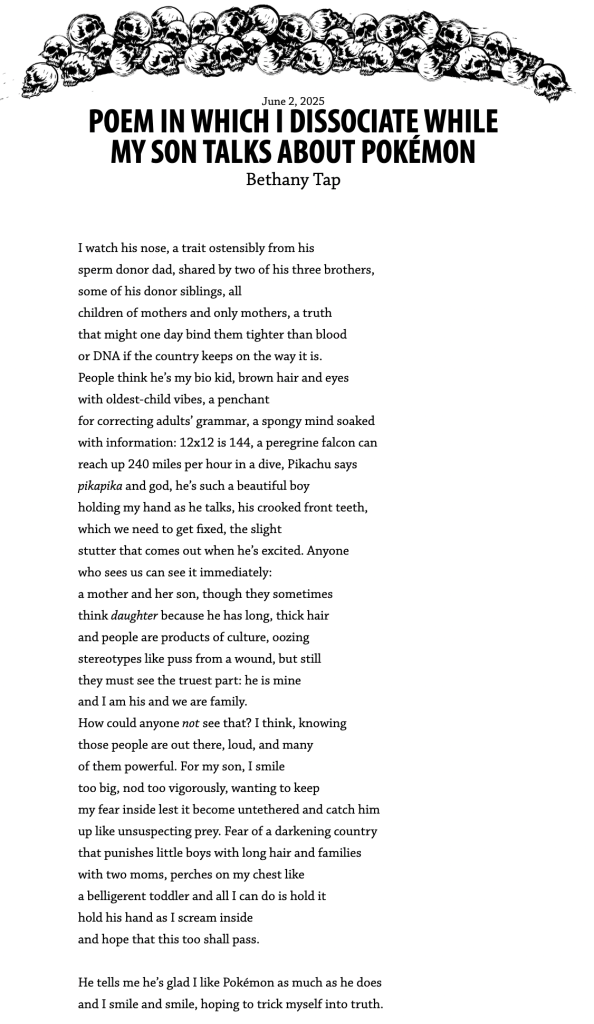
Here are the things that I admire about this poem.
Getting more concrete by inserting a very specific idea instead of a very specific noun
One of my favorite parts of the poem is the 12×12=144. I love it because it’s one of those details that makes the poem feel so vivid, yet it’s not a person, place, or thing you can picture.
When I’m writing, and I want to add more specifics into my poem, my natural instinct is to think of:
- Adding in more nouns (i.e. you see a woman on the side of the road? what if she’s eating bread?)
- Making existing nouns more precise (i.e. what flavor of bread is she eating? what’s the specific brand of the bread?)
- Describing existing nouns more vividly (i.e. how big is the bread? what if the bread was the same size as the woman eating it?)
While this poem does have its specific nouns and vivid descriptions, the list of specific ideas the son knows is just as effective, if not more effective, at bringing the story of the poem to life; 12×12=144 doesn’t paint a picture of what the child looks like, but it still paints a picture of who he is.
Telling, not showing, as a gut punch
One of the lines that grabbed me in this poem was “and god, he’s such a beautiful boy.” Something I’ve noticed I really enjoy in a poem is a straightforward line that stops you in your tracks, a line that suddenly arrives to say “Hey. I’m not mincing my words here. This is what is most true to me. I’m putting it plainly because I need you to know this.”
Many of us were taught that the best way to improve our writing is to show not tell. In fact, if this is poem was brought for a peer critique in one of my college poetry workshops, I can picture student writers (including myself) telling the author to cut the beautiful boy line because it feels like the right thing to say. Why tell us he is beautiful when you are showing us his nose, hair, and teeth?
Yet I love the beautiful boy line so much because it briefly takes the reader from a the more frantic place in the author’s head (what’s my son talking about at the moment? what do other people think? where is the country going?) into her place of joy. She adores her son. He is precious to her. Everything is chaotic, but this is what she knows for sure. She needs to pause and tell you that point blank so you know what’s at stake for her, and you don’t forget it.
I like the idea of reframing “show don’t tell” to “if you’re going to tell, make it mean something.” I also like the idea of setting aside conventional wisdom, experiencing art, and deciding for yourself whether conventional wisdom applies, instead of letting conventional wisdom keep you from appreciating something wonderful and human.
-
Subscribe
Subscribed
Already have a WordPress.com account? Log in now.
 Andrea